
critical infrastructure

Cybersecurity and AI Frameworks

AI is everywhere nowadays and will transform cybersecurity attacks and defense both now and in the near future. The cybersecurity landscape is fundamentally changing as adversaries deploy sophisticated AI agents, redefining cyber-attack economics and dynamics. Especially for critical infrastructure, it is crucial to be protected and resilient.

Just to bring a few important attacks back to your mind:

  • Colonial Pipeline

  • Water supply infrastructure in Oldsmar (Tampa, US)

  • AI-automated attacks recently at McKinseys Lilli Plattform

Critical infrastructures are essential. Just a few examples of what this means:

  • Citizens will not be without “clean water” for more than 8 hours.

  • Hospitals and emergency services: no more than 2 hours.

  • Commercial buildings: no more than 4 hours.

  • Electricity is even more crucial.

“AI-powered cybersecurity tools alone will not suffice,” Michael Siegel from the MIT Sloan (CAMS) said. “A proactive, multi-layered approach - integrating human oversight, governance frameworks, AI-driven threat simulations, and real-time intelligence sharing - is critical.”

The 3 AI defense pillars every organization needs

A comprehensive approach to combating AI-enabled threats consists of three types of defense, all of which are essential:

AI automated security hygiene,

such as self-healing software code, self-patching systems, continuous attack-surface management, zero-trust-based architecture, and self-driving trustworthy networks. Agentic AI will automating these routine tasks reduces manual workloads while strengthening protection against attacks that target core system vulnerabilities.

AI autonomous and deceptive defense systems,

which use analytics, AI, and real-time data collection to learn from, identify, and counteract threats. Examples include simultaneously Agentic AI moving-target defense and deceptive tactics and information. Both types of systems enable teams to take a proactive approach to defense rather than getting stuck in reactive mode

AI augmented oversight and reporting,

which give executives real-time, data-driven insights. For example, AI augmented risk analysis to spot emerging threats with advanced CTI and predict how they might impact an organization.

There are more frameworks available or currently in the process of being defined.

We selected the MIT Sloan AI Secure-by-Design Framework as one of the most advanced frameworks.
It emphasizes autonomous AI defenses that adapt to threats faster than human defenders.

And exactly this is what is required in the fast-changing cyber landscape.

CTI (Cyber Threat Intelligence) is playing an increasingly important role, especially when it comes to tracking emerging trends.

  • More intelligence

  • More adaptive

  • More autonomous security with pre-emption mechanisms

We have developed a comprehensive Agentic AI powered CTI framework that addresses all these topics:
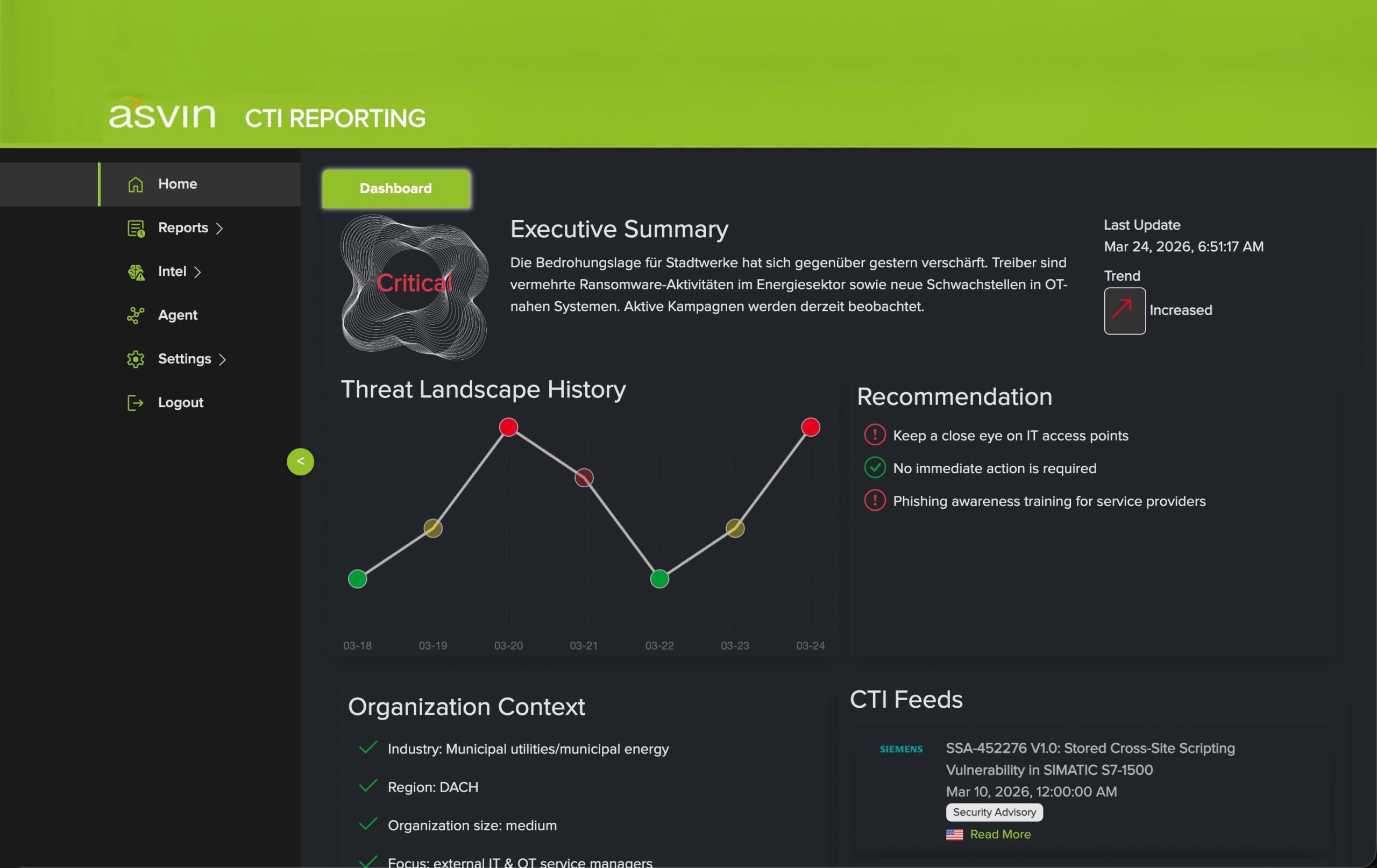
Cyber Threat Intelligence Reporting asvin Platform

Stay ahead of threats with real-time, contextualized cyber intelligence.

Our dashboard turns fragmented CTI and vulnerability data into actionable insights, so your teams can prioritize risks, respond faster, and stay compliant with EU NIS 2 and other regulations - all without adding headcount.

Ready for Decision-Ready CTI?

Discover how context-optimized CTI reporting can make your organization more actionable, faster.

Check today, without obligation, which steps make sense for you – our experts are here to guide you.