Twelve hours to attack: How AI agents are rewriting the rules of industrial security
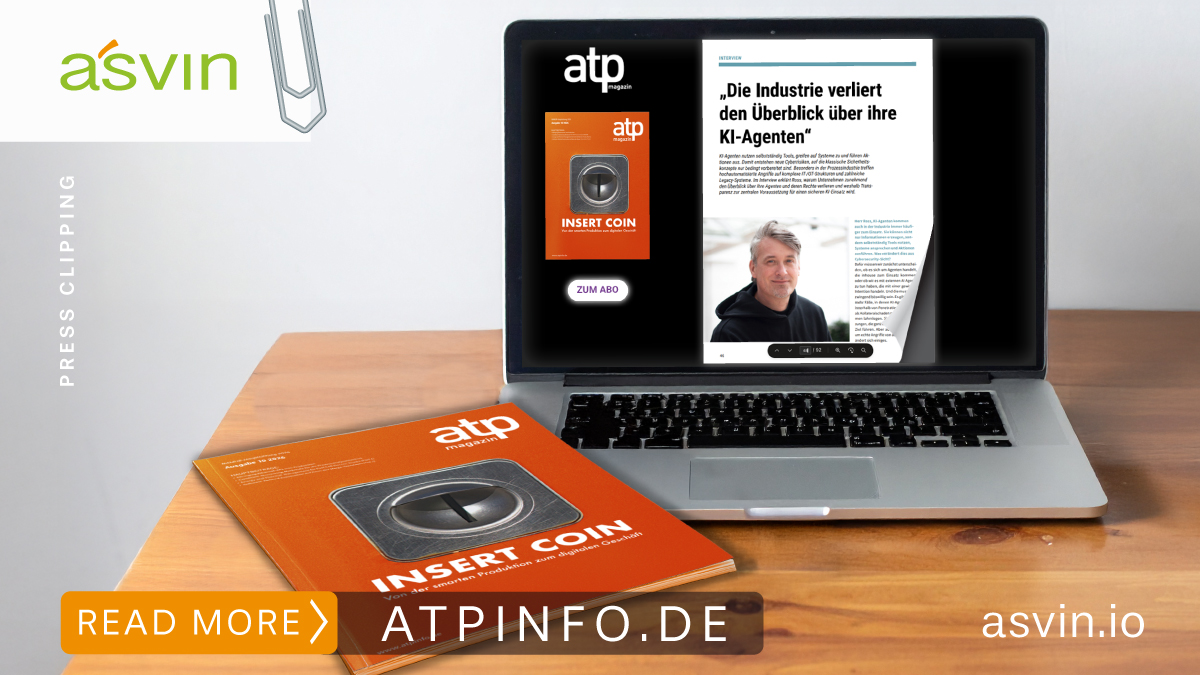
In interview with ATP Magazin, asvin CEO Mirko Ross explains why companies are losing track of their AI agents and why transparency has become the most important requirement for better security. Less than twelve hours: that is how quickly a newly published vulnerability is exploited today. Five years ago it took three weeks, and last year three days.
“The window for responding to vulnerabilities and for creating and installing patches has shrunk dramatically. In practice, it has become almost impossible,” says Mirko Ross, founder and CEO of asvin, in an interview in the current issue of ATP Magazin.
AI agents are driving this development.
They do more than provide answers: they use tools, access systems and carry out actions on their own. As a result, attacks become more frequent, more automated and easier to scale. This is a particular concern for the process industry, where complex IT/OT environments meet a large number of legacy systems.
Even so, Ross does not think panic is warranted. Many of the incidents that have come to light were caused by human error, for example when a model is given the entire toolbox without clear limits. In his view, the bigger problem is that many companies lack the know-how to protect themselves. Economic pressure means they deploy AI agents anyway, often in a “what could possibly go wrong?” frame of mind.
Yet it is hard to control what an agent actually does. AI agents work statistically, not deterministically. Conventional monitoring tools measure traffic and log access, but they cannot see the intent behind an action.
There is also a structural problem: agents are identities, just not human ones, and identity management does not yet account for them. The result is shadow AI. Many companies no longer know how many agents they are running or what permissions those agents have.
For Ross, transparency therefore comes first.
Companies need to establish which agents exist, who created them, what they are allowed to do and which ones are no longer in use. Only then can they decide where a risk is acceptable and where it is not. He sums up what is at stake in a single sentence:
“Hacked AI agents are not just a software threat. They can endanger people and the environment.”
The full interview also covers the Hugging Face incident and asks why the true intent behind a prompt may never be reliably detected through automation.
Read about it now in ATP Magazine: https://atpinfo.de/ausgabe/atp-magazin-10-2026/

Konrad Buck
Head of Press and Media Relations
Background & Expert Access for Media
- Product & technology insights – technical context, solution architecture, and real-world use cases for professional and trade media
- Expert commentary & background talks – our CEO is available as an expert source on current cybersecurity developments, threat landscapes, and the impact of AI on security and regulation
I speak openly, fact-based, and without PR spin. I am a former IT journalist with decades of experience in the IT and cybersecurity space, familiar with the highs and lows of the industry. Off-the-record discussions are possible upon request.